
Understand the four-part journey
Learn how to approach the collection before beginning the source readings. These are original orientation lessons, not the book's full text.
Original course explanation and practice — not the author’s wording.
Arabic vocabulary with pronunciation and meaning (9 entries)
Arabic study vocabulary
Read across each row: vowelled Arabic, pronunciation helper, then English meaning. Forms are learning aids; grammatical endings can change in a sentence and may be omitted when pausing. Transliteration does not replace listening to a qualified teacher.
| Arabic with harakat | Transliteration | English meaning |
|---|---|---|
| إِحْيَاءٌ | iḥyāʾun | revival; bringing to life |
| عُلُومٌ | ʿulūmun | sciences; branches of knowledge |
| دِينٌ | dīnun | religion |
| إِحْيَاءُ عُلُومِ الدِّينِ | Iḥyāʾu ʿulūmi d-dīni | The Revival of the Religious Sciences — the collection's title |
| إِمَامٌ | imāmun | a leader; here, an honoured scholarly title |
| اَلْغَزَالِيُّ | al-Ghazāliyyu | al-Ghazali — the author's name, not an ordinary vocabulary noun |
| عِلْمٌ | ʿilmun | knowledge |
| عَمَلٌ | ʿamalun | action; practice |
| نِيَّةٌ | niyyatun | intention |
JavaScript is off. Read all explanations and reveal the answer guides below. Interactive checking needs JavaScript.
Today, you can…
- Name the four broad areas of study
- Explain how inward motives and outward actions can be studied together
- Distinguish a forty-book collection from forty short lessons
A map before a long journey
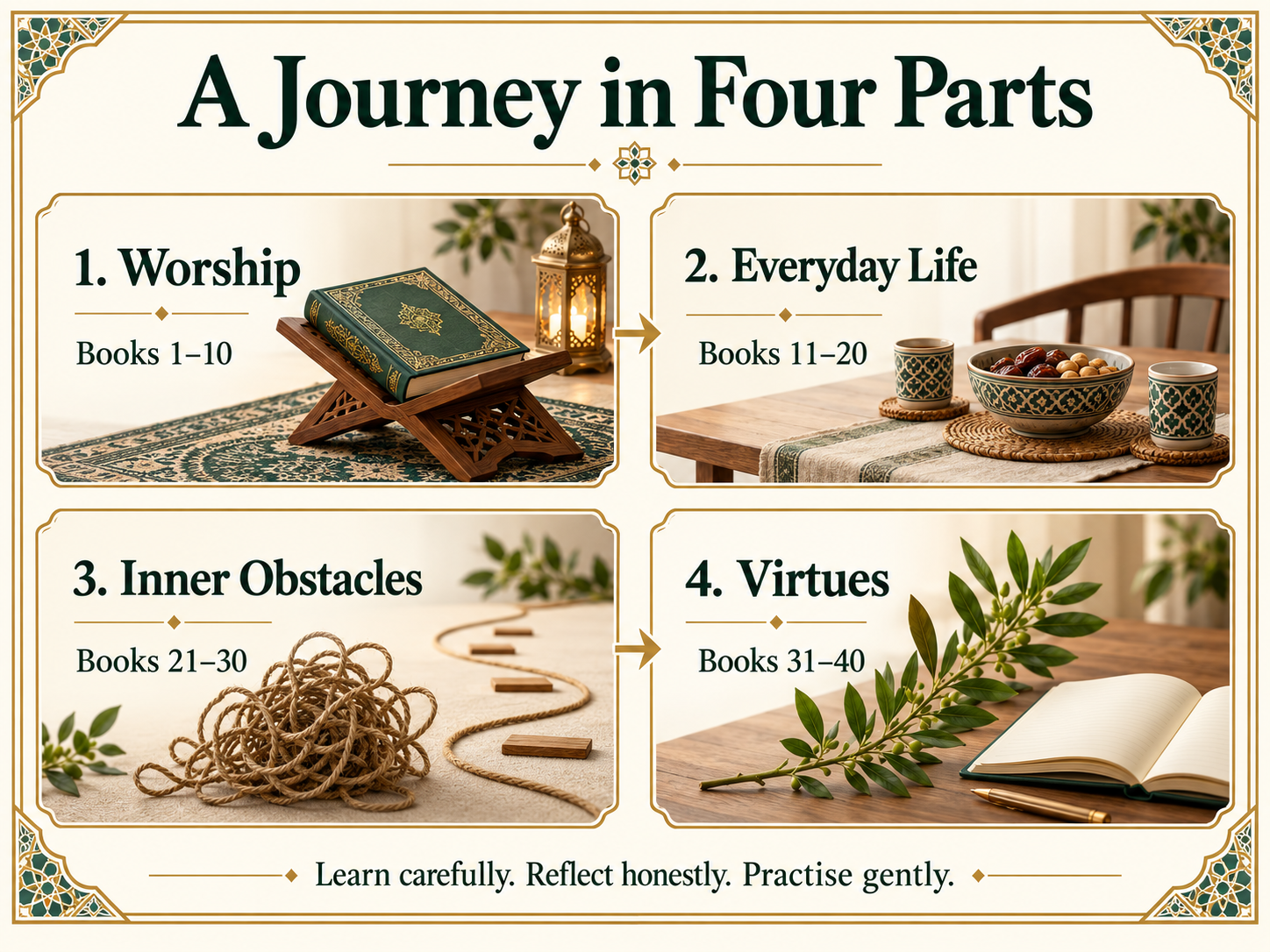
A large classical collection can feel overwhelming when every subject appears equally urgent. Begin with a map rather than trying to remember everything. This collection has four parts, with ten books in each. Here, a book means a substantial unit within the collection; it does not mean one short lesson. A single book may need many reading sessions. Our aim is careful understanding, not racing through a table of contents.
Four connected areas
The first part concerns worship and its meaning. The second brings attention to ordinary life and relationships. The third examines harmful inner habits, while the fourth considers virtues and constructive spiritual development. These areas are connected. Giving, for example, is an outward action, but its intention and the treatment of the recipient also matter. The four-part map helps you locate a discussion without pretending that real life fits into four separate boxes.
Understanding is more than remembering a label
Suppose you read about considerate speech. You can remember the topic's name and still struggle to listen patiently. A useful study session therefore asks three questions: What does this passage say? Can I explain it in ordinary words? What small, responsible action could follow? The course's explanations and activities support that process. They must remain visibly separate from the source text so that you can tell the author's words from our teaching suggestions.
Permission to begin slowly
You do not need prior Arabic study to begin. The vocabulary table supplies script, vowel markings, transliteration and meaning together. Use the English explanation first if the Arabic is unfamiliar. Return to the table when a term becomes important. You are not being tested on pronunciation in these orientation activities. It is reasonable to reread, ask a question, or stop after one useful insight.
The four-part learning map
- 1Worship
Books 1–10: learning and acts of worship.
- 2Everyday life
Books 11–20: conduct, relationships and shared life.
- 3Inner obstacles
Books 21–30: recognising harmful dispositions and habits.
- 4Virtues
Books 31–40: constructive spiritual qualities and reflection.
One action, several questions
- A learner decides to give a useful book to a friend.
- The outward action is giving; ordinary manners include asking whether the friend wants it.
- The learner also considers whether the aim is to help or to win praise.
- The example shows why conduct and intention can be considered together without judging another person's unseen motives.
Explain the map in your own words
- Name the four parts without looking, then check the map.
- Choose an ordinary action such as sharing food or keeping a promise.
- Write one question about the outward action and one about your own intention.
Show a model answer or success guide
For keeping a promise: outward question — did I do what I agreed to do? Intention question — was I trying to be dependable, or merely to look impressive? I can examine my own motives without claiming to know another person's heart.
Check your understanding
Choose an answer, then check. You can try again as often as you like. No timer, marks or saved responses.
Recall cards
Say your answer first. Open a card to check.
How many broad parts are there?
Four, with ten books in each.
Does one book necessarily equal one lesson?
No. A source book can be divided into several manageable reading lessons.
What belongs beside the source text?
Clearly labelled explanation, vocabulary, examples and opportunities to practise.
Make the connections
Match each prompt to its partner. Use each answer once.
Show the matching guide
Pause and reflect
Which of the four areas feels most familiar, and which raises a question you would like to explore?
Take it into your day
Choose one ordinary action tomorrow. Notice what you did and what you hoped to achieve. Keep the reflection private if you prefer; do not attempt to diagnose another person's motives.
Talk about your answer or write it on paper. Nothing you answer here is collected or stored.
Sources and learning notes
Source readings reproduce Ghazali.org’s unedited HTML transcription of Fazlul Karim’s summarised English edition. All 41 source chapters across four volumes are included in order, mapped to 40 canonical books. Whitespace is normalised; original wording, spelling and source page markers are retained. Course explanations, diagrams, scenarios and activities are original teaching aids, not quotations from the author.
- Ghazali.org overview of the Revival of the Religious Sciences (new tab)
The four quarters, forty-book organisation and distinction between different English editions and summaries.
- Fazlul Karim’s summarised English edition — source chapter index (new tab)
All 41 unedited HTML source chapters. Full reading text is embedded in this course; external links are optional provenance only.
- The complete selected summarised edition is included; this is not an unabridged translation of the Arabic original.
- Coverage is checked against the 41 selected HTML source chapters, not a line-by-line proofread against printed scans. The source labels this transcription unedited; spelling, OCR and formatting errors may remain.
- Arabic tables supply vowelled learning forms, transliteration and meaning. The source’s original romanised spellings are preserved. Tables are a study glossary, not an exhaustive identification of every historical name or a new Arabic edition.
- Narrations, historical medical claims and legal discussions are preserved as source material; inclusion is not independent authentication, medical advice or a current personal ruling.
- AI-assisted teaching material and editorial vocabulary aids have not been certified by a qualified scholar or Arabic teacher. Discuss difficult passages with a qualified teacher.
- Practice is ungraded and does not change LearnPress progress. Use LearnPress’s normal lesson controls separately. No exercise responses are collected or saved.