Studying Seerah with Children: Stories, Questions and Simple Maps
Seerah & History · READ & PRACTISE · ABOUT 5 MINUTES
A child may remember the name of an event while still wondering who was involved, where it happened or why it mattered. A simple study routine can make those questions welcome. Begin with a reliable, age-appropriate account and a manageable passage. The aim is understanding, not a dramatic performance or a competition to remember the most dates.
Keep the source and the retelling separate
Read the selected passage together. If you simplify it, explain that you are retelling it in easier language. Do not add invented conversations, feelings or details and present them as established history. An imaginative modern example can be useful, but label it as an example rather than an event from the Prophet's life.
When a child asks something the passage does not answer, say so. Make a question card for a qualified teacher or a reliable reference. 'We need to check' is better than filling a gap with a confident guess.
Build a three-question story frame
For a younger child, these can be spoken answers. An older learner can write one sentence for each. Avoid requiring a child to disclose a frightening or private experience in order to connect with a story.
- What does the account say happened? Identify the event without adding extra details.
- What helped me understand it? Notice a place, a relationship or the order of events.
- What question remains? Keep uncertainty visible instead of treating it as failure.
Use a timeline before a detailed map
Place three verified events in order using cards marked 'before', 'during' and 'after'. If exact dates are not supplied or have not been checked, do not invent them. Sequence can be a useful first step even when a learner is not ready for a full chronology.
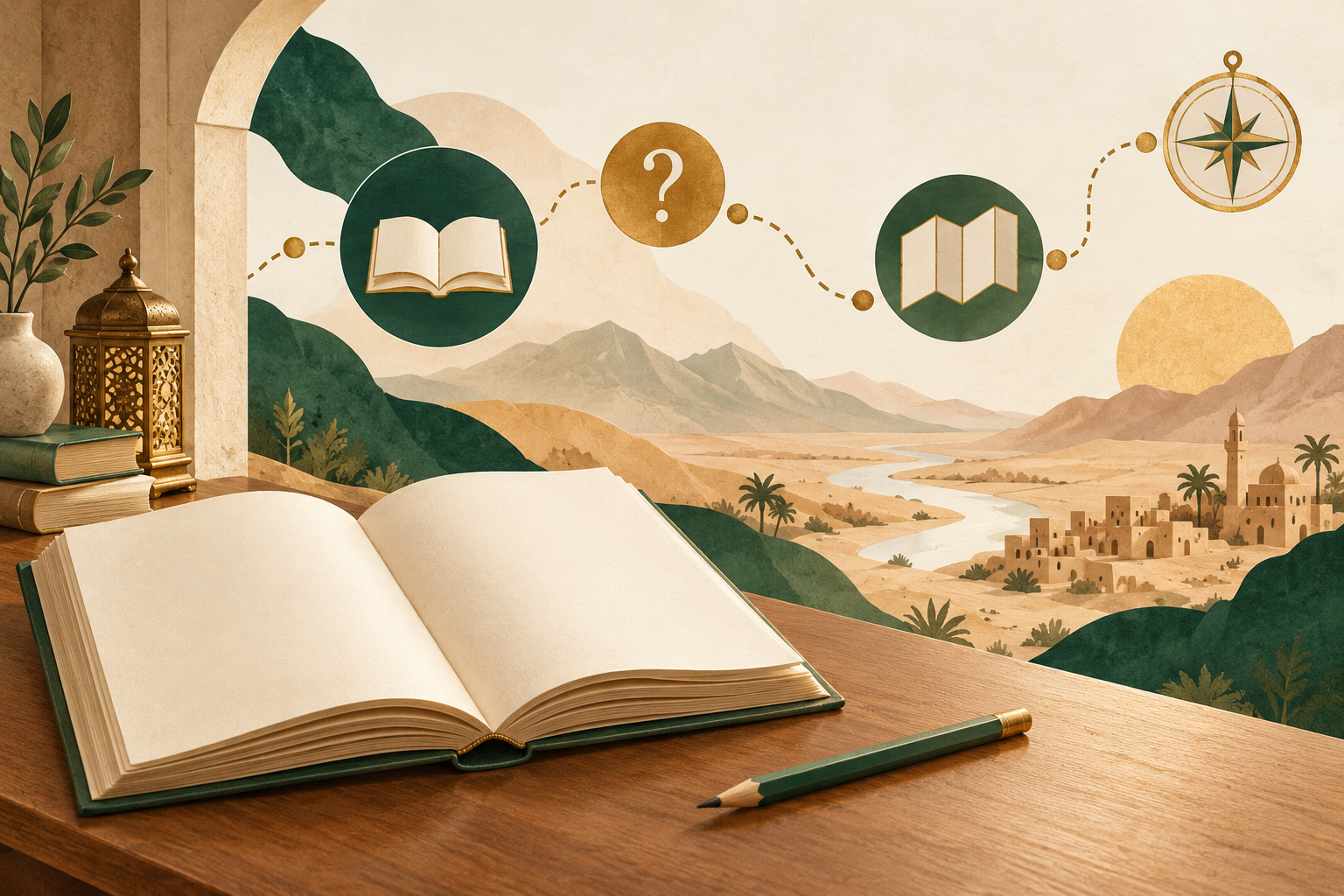
For geography, use a reliable labelled map when teaching an actual location or route. A hand-drawn line between two circles can represent the idea of a journey, but it should be called a concept diagram, not an accurate historical map. Our article illustration is conceptual, not a reconstruction of a particular route.
Discuss conduct without forcing a simplistic moral
Ask what a reported action helps you notice: patience, responsibility, generosity or care for another person. Then distinguish that discussion from a new classroom scenario. A modern example should not be described as a direct quotation or a replacement for the historical context.
Some accounts involve conflict or loss. Choose material suited to the learner, avoid unnecessary graphic detail and allow a pause. A thoughtful discussion does not require depicting the Prophet or acting out sacred figures. Use books, places, timelines and non-figurative diagrams instead.
Finish with one careful recap
Invite the learner to retell a small part in their own words, then compare it with the passage. Ask what is in the text and what is their own interpretation. Correct a factual mix-up gently and keep one unanswered question for later.
The Sealed Nectar course on Dar Al Hamd provides a place to continue structured study. Use its source readings and learning aids together, and consult a qualified teacher about difficult reports or interpretations. The reflection journal can hold a source note, a question and a modest everyday application without requiring public sharing.
Make a story-and-question card
After one passage, write: 'The text says…', 'My explanation is…' and 'I still wonder…'. Add only a location or date that you have checked.
Open a suggested response
A strong card distinguishes a source fact from your explanation and keeps an honest question. If the source does not establish a date or motive, leave it unclaimed rather than guessing.
Continue your learning
Original Dar Al Hamd learning guidance. Activities are suggestions, not religious requirements. Illustrations are conceptual learning aids.